
Key takeaways at a glance
Blockpit is in 2026 an established crypto tax tool with a strong Austrian focus and simplified UX, at its best with simple exchange setups and source-of-funds reports, and at its limits with complex DeFi and multi-year cleanup.
- ✓ Since Q4 2025 the first tool-native source-of-funds feature in DE+AT (€19.99 per single report)
- ✓ Limits: complex DeFi structures, multi-year cleanup (each tax report is billed separately)
- ✓ From 600+ documentation cases: for multi-year and power-user activity Blockpit hits the same limits as all crypto tax tools
You picked Blockpit because it comes from Austria, the Trustpilot check looked positive and the interface didn't feel overloaded compared to other tools. Three months later you notice: on your multi-year setup the dashboard shows inconsistencies, individual integrations carry warning icons, the new source-of-funds report stumbles on a bank request, and the tax report contains values you can't explain. Is it you, or is it the tool?
Based on experience from 600+ crypto accounting cases — many of them with Blockpit setups — this article shows what really makes Blockpit strong in 2026, where it hits limits, which typical errors show up in practice, and above all: how the brand-new source-of-funds feature performs in real-world use.
01 What Blockpit 2026 really does well
Blockpit has six strengths in 2026 that make it one of the strongest options in the German-speaking market.
1. First crypto tax tool with an integrated source-of-funds feature. Since Q4 2025, Blockpit generates a compliance-grade source-of-funds report from the imported transaction data, with multi-level visualization of capital flow back to the original fiat deposits. Blockpit was the first tool in the German-speaking market to generate this report natively. CoinTracking has since followed – the difference today is in the level of detail, not in availability. We analyze the feature in detail further down using a real-world report example.
2. Fixed tax framework with verified logic. Blockpit positions itself as a tax tool with fixed calculation rules for German and Austrian tax law, verified by Blockpit. For the standard investor that's a real UX simplification: fewer configuration hurdles, clearer default assumptions, explicitly explained on the final pages of every tax report.
3. Strong community work across multiple platforms. Own forum, Telegram group, Reddit, Discord. Plus regular AMAs with tax experts and Florian Wimmer (Blockpit CEO). If you're active in the crypto-tax community, you get direct access to answers. Few competitors offer this intensity.
4. UX and UI for manageable portfolios is clearly superior. In initial conversations with clients, we regularly hear this as the decision criterion: "Blockpit was easier to use." If you have a few CEX accounts, normal trading activity and no DeFi stress, you find your way around Blockpit faster than in more complex tools.
5. Balance reconciliation between API and imported data directly in the dashboard. Per integration, you can immediately see whether the imported trades match the exchange's API-reported balance. On discrepancies, the difference is shown. It's a review mechanic without much clicking around, and in practice one of the points where Blockpit catches problems earlier than other tools.

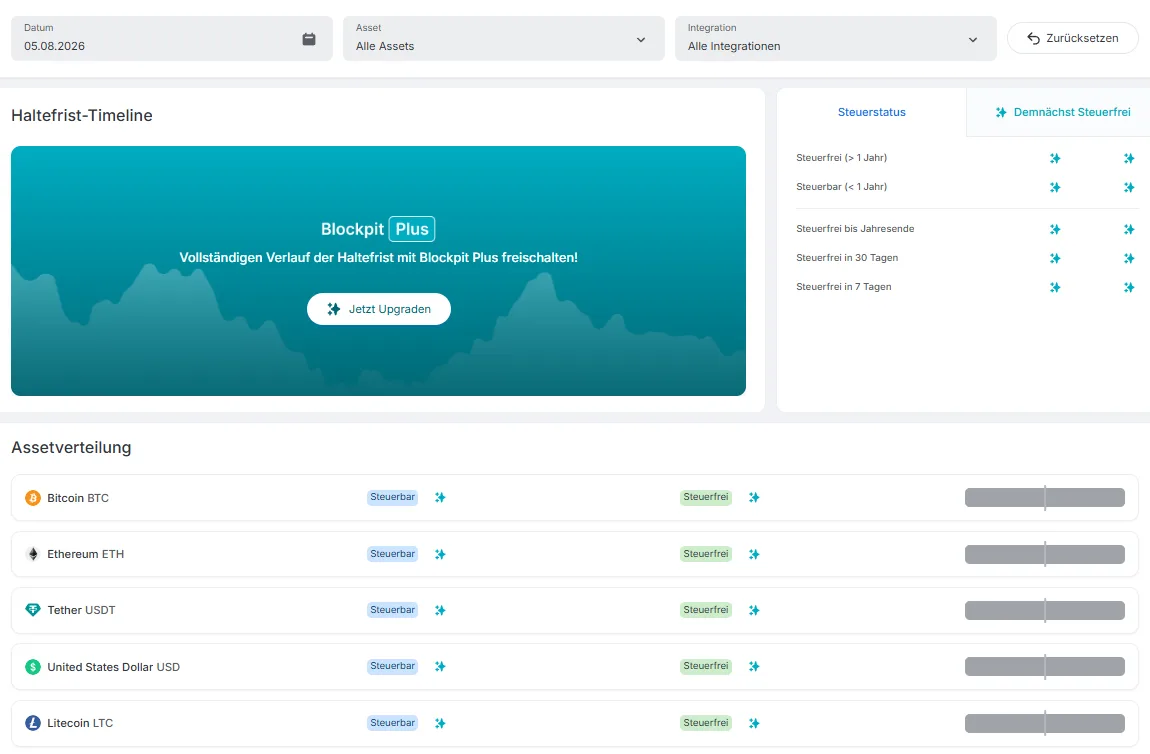
6. Holding-period analysis for German users (new in 2026). A dedicated menu section shows the tax status per asset: tax-free after more than one year, taxable below that, plus a preview of what turns tax-free within the next 7 and 30 days and by year end. For the German one-year rule that is a useful addition, because it surfaces the status instead of burying it in the report. One limitation: the full holding-period timeline sits behind Blockpit Plus – without the subscription you only see the current status.
02 Where Blockpit hits limits
For all its UX strength: Blockpit has four structural weaknesses that show up regularly in documentation cases.
1. Complex DeFi structures need more manual work. There are fewer DeFi labels and smart-contract recognition is weaker than in DeFi-oriented tools. But: recently labels for loans and even prediction markets were added. We haven't seen the latter in any other tax tool. Blockpit is catching up structurally, but for decentralized power-user setups it isn't at top level yet.
2. Manual editing of blockchain-import transactions is restricted. Transactions sourced from the auto blockchain import can only be edited in a limited way afterwards. For more complex or bulk corrections you often have to work with workarounds. What improved in 2026 – and what did not: the editing restriction itself remains. What did get considerably better is traceability: every transaction now has an „Edits“ tab that logs what was changed and how, and restores the original state via „Reset transaction“. Transactions can also be flagged as „Marked for review“ or „Marked as reviewed“ and filtered accordingly. That matters when working through large holdings, because otherwise you only see the source of a transaction – not whether someone edited it afterwards.
3. Blockpit Plus as a paywall. The Plus subscription layer separates platform features (auto-sync, tax optimization, chart options, NFT gallery) from the base account. The trend continued in 2026: the new holding-period timeline also sits behind Plus, and support increasingly runs through the LIA assistant or the paid Expert Service. Whether it is a weakness or a normal SaaS model is for you to decide – building a product costs money. What matters in practice is a different question: anyone who needs a reliable assessment of a concrete data problem gets it neither from a chatbot nor from the vendor whose tool produces the numbers.
4. The "Autobalancing" label as a hidden risk. Blockpit lets users "balance out" negative holdings via an Autobalancing label. In practice it's often used without getting to the root cause. Negative balances are a symptom of a missing purchase, missing transfer or broken link. Autobalancing makes the tax report look clean, but the underlying documentation stays broken.
03 4 typical error detection paths in Blockpit
When a Blockpit setup comes in for documentation cleanup, it's almost always the same four problem patterns. Blockpit shows three of them transparently — once you know where to look.
1. Discrepant balances between import and API. When your imported trades don't match the exchange's API-reported balance, Blockpit flags it with a blue exclamation marker in the integrations overview. Click-path:
Dashboard Integrations Exchange with blue marker Discrepant balanceThe difference is shown concretely in asset amount and EUR value. Ignore this and you build on inconsistent data — the tax report ends up wrong automatically.
2. Missing history. When assets are sold or sent for which Blockpit didn't recognize a purchase (classic: more sold than bought → negative balance), it's flagged in the transaction list as "Missing history". Click-path:
Transactions Filter Warning Missing historyThis list must be empty before every tax report, otherwise sales get valued with an unclear cost basis.
3. Missing value. Some transactions Blockpit recognizes, but it can't assign a EUR value based on the asset — often with spam tokens, new coins without pricing data, or obscure trading pairs. Click-path:
Transactions Filter Warning Missing valueThese transactions should be reviewed and, where appropriate, marked as spam or set with a manual value.
4. Unlabeled (In) or Unlabeled (Out). Transactions that are recognized but not correctly assigned a label appear as "unlabeled". Click-path:
Transactions Filter Unlabeled deposit / withdrawalIf you see 40-60 percent of your transactions flagged with warnings (this happens more often than you'd think), you have structural documentation problems, not a UI problem.
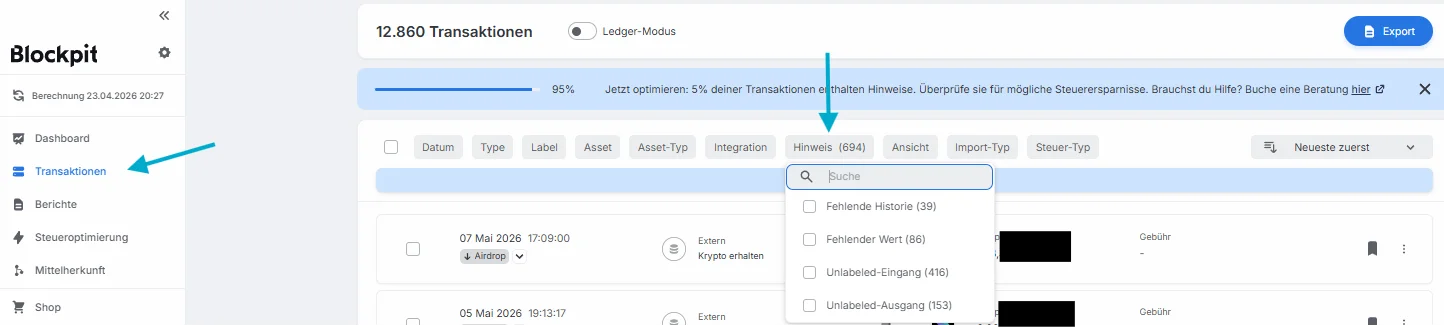
Transactions → Filter → Warning.
Walking through these four paths before every tax report catches 80 percent of typical Blockpit errors. The rest is covered by the specific hubs for Blockpit errors, Blockpit balance discrepancy and Blockpit unlabeled transactions.
04 Source-of-funds 2026 — practical check of the USP feature
In Q4 2025, Blockpit was the first crypto tax tool in Germany and Austria with a native source-of-funds feature. CoinTracking now offers one as well – the edge today lies in the level of detail, not in exclusivity. The feature itself: a compliance-grade report that, based on the imported transaction data, visualizes the capital flow back to the original fiat deposits. We analyzed a real report from practice.
What the report actually delivers (real-world example: anonymized BTC payout proof in Q2 2026):
| Metric | Value |
|---|---|
| Investigation period | ~4.2 years of history |
| Captured transactions | ~150 |
| Total links | ~185 |
| Data sources | 6 (mix of CEX CSV, blockchain imports and wallet connections) |
| Data mix | ~60% CSV / 26% blockchain / 14% manual |
| Breakdown | Fiat deposits just over 100% of the payout value − minor trading loss in the low single-digit percent range |
Report structure (15 pages, 8 sections): Overview → AI-generated origin summary → Data-source listing → Source-of-funds structure → Flow diagram (simplified) → Flow diagram (full, all paths) → Transaction details level 1-14 with all hashes and CSV IDs → Notes.
What this means in practice:
- ✓ Real compliance-grade trace — AML/KYC structure, every cent traceable back to fiat deposit
- ✓ Capital-flow visualization at two detail levels — the bank clearly sees where the funds come from
- ✓ Wallet and exchange addresses with linked blockchain transactions
- ✓ Attractively priced — €19.99 per single report, fair for a 15-page compliance document
Where the report hits limits:
- ⚠ "Missing history" markers stay visible. If your documentation has gaps, the report shows them as markers but doesn't fill them. Banks and tax offices ask exactly there.
- ⚠ Manual share in the example report ~14 percent. That's the preparation work the tool doesn't do itself. Without clean manual additions, the trace has gaps.
- ⚠ Disclaimer on page 15 makes it clear: the user is responsible for completeness. The report does NOT replace an officially audited source-of-funds confirmation. Blockpit is not liable for incomplete data.
The honest take: Blockpit's source-of-funds feature is a unique tool in 2026. The fund-flow visualization is among the most detailed the tools currently offer in Germany and Austria. But the tool doesn't reconstruct data, it visualizes what's already documented. With incomplete crypto accounting, the report contains "Missing history" markers — and that's exactly where banks and authorities ask. Complete documentation is the prerequisite, not the output of the report.
More on this topic: Source of funds for bank inquiries and Source-of-funds for cryptocurrencies — what banks really want.
05 Blockpit pricing 2026 — three pricing models you need to know
Blockpit's pricing is structured differently from other crypto tax tools. Three separate price components, each billed independently as needed.
Model 1: Blockpit Plus (platform-features subscription), €47.90/year. Includes: tax optimization, daily sync, all chart options, advanced insights, NFT gallery. Plus is the platform subscription. Without it, Blockpit runs as a reduced free version.
Model 2: Tax report (one-time purchase per tax year). Pricing is based on trade volume for the respective tax year:
| Tier | Transactions | Price |
|---|---|---|
| Small | 50 | €49 |
| Medium | 1,000 | €99 |
| Large | 3,000 | €149 |
| X-Large | 10,000 | €229 |
| XX-Large | 10,000+ | €549 |
Important: Tax reports are purchased separately per tax year. Cleaning up five past tax years means paying five times. For active multi-year cleanups, this is a significant cost factor.
Model 3: Source-of-funds report (credits, per single report).
- 1 credit = 1 report = €19.99
- 3 credits = €49.99 (€16.66/report)
- 5 credits = €79.99 (€16/report)
What does this mean in the decision? For single-year setups with Plus features, Blockpit Plus (€47.90) is very fairly priced. For multi-year cleanups, Blockpit gets expensive fast because each tax report costs separately. If you need source-of-funds reports, Blockpit offers one of the most mature tool-native options in the German-speaking market. €19.99 per report is cheap for a 15-page compliance document.
06 Use cases — where Blockpit shines, where it needs rework
Note on the scale: The rating describes where manual rework is needed — not where Blockpit is worse than other tools. Other crypto tax tools have similar limits on the 5-6/10 use cases. Blockpit does a lot right across the board.
| Use case | Blockpit score | What that means in practice |
|---|---|---|
| Simple CEX (Bitpanda as the main example) | 10/10 | Sweet spot — UX and default classification perfectly aligned |
| Multiple CEX (Binance, MEXC, KuCoin) + years back | 6/10 | Demanding, lots of work with import templates |
| Standard DeFi swaps on EVM | 9/10 | Works nearly every time |
| Non-EVM/SOL or advanced orders (Jupiter DCA/LIMIT, bridge swaps) | 5/10 | Manual rework almost always required |
| Multichain imports (good) + bridging / bridge swaps (critical) | 6/10 | Import coverage strong, but bridges always need editing |
| Source-of-funds report from imported transactions | 10/10 | Very mature in a tool comparison — prerequisite: data complete |
Performance clusters:
10/10 sweet spot: Simple CEX setups (Bitpanda as the ideal case) and the source-of-funds feature. That's Blockpit's USP zone. If you operate here, you get the best tool experience available.
9/10 strong: Standard EVM DeFi swaps. As long as you're on Ethereum standard paths, it works reliably. Bridge swaps like swapping between coins directly on a Tangem Card are also well captured here.
6/10 rework needed: Multichain with bridging. Imports come in cleanly, but bridges are often misinterpreted and require manual editing.
5/10 critical: Multi-CEX setups with years of history (Binance + MEXC + KuCoin + old archives) and non-EVM advanced trading (Solana-Jupiter with DCA/limit orders). Manual rework is almost always required here. This is where the tool reveals itself as exactly that — a tool, not a self-driving car.
07 When Blockpit isn't enough, and you need an accounting partner
Five signals from the experience of Robert and Johannes (600+ cases since 2021) indicate that the tool alone is no longer sufficient:
1. Complex DeFi history with a high share of unlabeled entries. When your transaction list consists largely of "Unlabeled deposit/withdrawal" and bridges + DeFi swaps aren't recognized automatically, no UI click helps. The smart-contract logic has to be reconstructed manually.
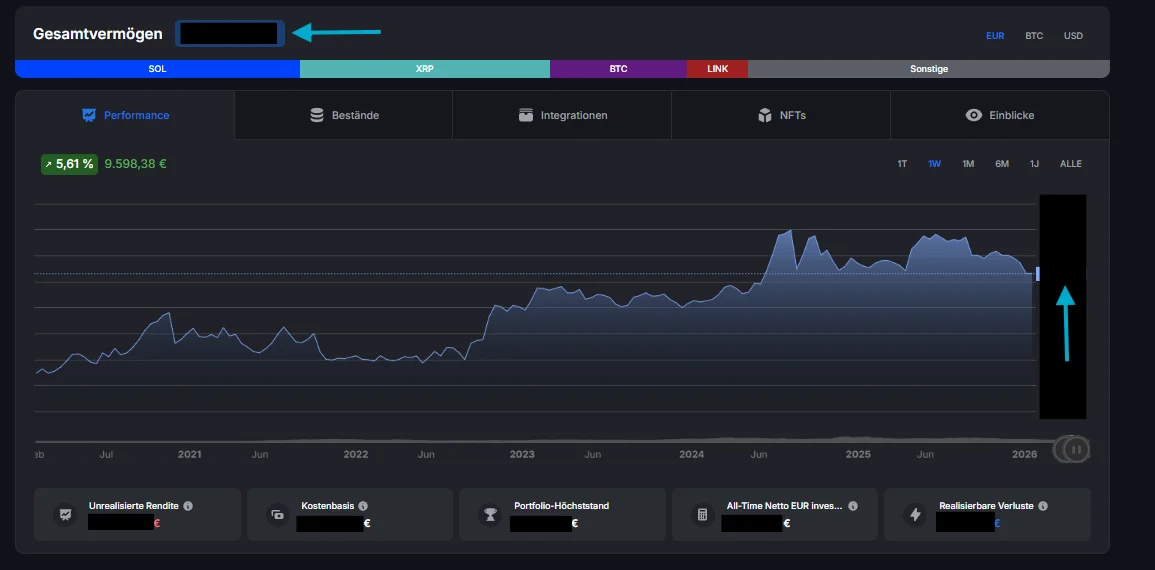
2. Dashboard performance vs graph value don't match. If your total portfolio value in the dashboard doesn't match the trajectory shown in the graph, you have discrepant balances. Fixing them often takes more than a few clicks. Classic documentation detective work.
3. Specific tax settings agreed with a tax advisor. Blockpit's fixed tax framework is a strength for the standard case. If your tax advisor needs custom calculation assumptions (FIFO vs LIFO per wallet, special staking treatment or specific DeFi logic), you hit tool limits.
4. Multi-year cleanup as a cost factor. Cleaning up five tax years means buying the tax report five times (X-Large tier €229 per year = €1,145 just for the reports). At this scale, it often makes sense to switch to a setup that doesn't bill per year, or to engage a professional accounting partner who handles the cleanup tool-agnostically and then sets up your ongoing Blockpit configuration.
5. 40 to 60 percent of your transactions flagged with warnings. We see this regularly in practice. When nearly every second transaction carries a warning icon, it isn't a filter problem. It's systematically incomplete documentation.
What actually causes this – four patterns from real cases
The warnings in the tool are the symptom. The cause almost always sits in the raw data, and it repeats. Four patterns keep showing up in documentation cases with six-figure portfolios – regardless of whether someone uses Blockpit, CoinTracking or Koinly:
1. Duplicate entries from overlapping imports. The same trades arrive once through the API and once through a CSV file. The balance looks plausible, but the history contains the event twice. In the tax report this produces gains that never existed.
2. Faulty API imports at individual exchanges. Bybit is the classic case: the connection runs technically, but does not transfer every transaction type completely. You see no error – you only see a result that is wrong.
3. Incomplete data from Binance and MEXC. Depending on period and product, both deliver only parts of the history. What is missing later surfaces as missing history or as holdings without origin – and then tends to get smoothed over with a balancing entry instead of being retrieved.
4. Solana as a case of its own. DeFi and trading activity on Solana is frequently not recognized by the tools for what it is. On top of that comes a technical limit: with wallets holding very large transaction counts, synchronization breaks off. The result is a wallet that looks complete but is not.
What these four patterns have in common
None of them reports itself as an error. The tool shows a balance that could be right and a report that runs through. Something like this can only surface when someone checks the data against reality – or when a bank or tax authority asks. That is why the first question with a conspicuous Blockpit setup is never „which label is missing“, but „which data is missing“.
A second opinion, not a support ticket
With a conspicuous setup there are two questions that tool support by its nature does not answer: is what I am seeing actually a problem – and what does it cost to resolve it properly? A vendor's support helps with operating its product. It does not assess whether the data foundation holds, and it will not tell you when a different tool would be the better fit.
That is what an independent second opinion is for. TX-Partner receives no commission from any tool and recommends none as a default – the work happens in Blockpit, CoinTracking and Koinly alike. The free consultation is therefore about three things: what is actually missing in your data, how much effort the cleanup realistically takes, and whether your current tool fits your case at all. Including when the answer is: everything checks out, you do not need us.
Important context
TX-Partner is not a tax advisor and does not provide tax assessments. The work ends where the data foundation is complete and verifiable – and that is exactly where your tax advisor's work begins.
08 Blockpit is a strong tool — the documentation underneath is the foundation
In 2026 Blockpit combines one of the most mature source-of-funds reports in the German-speaking market with clear UX and a verified tax framework. If you operate in the sweet spot (a manageable CEX portfolio anchored by Bitpanda, normal EVM DeFi activity, occasional bank inquiries), Blockpit gives you a setup that runs cleanly with little fine-tuning.
What Blockpit doesn't replace: clean documentation underneath. Tools calculate tax liability from what's documented. Even the best source-of-funds report can only visualize what's already in the data. On gaps the report shows "Missing history" markers — and that's exactly where the bank asks.
Free consultation, 30 minutes, no obligation. You either leave with a clear plan or with the confirmation that your Blockpit setup is fine as it is.
Also relevant: CoinTracking vs. Blockpit 2026: Which tool fits you? — the direct comparison with a practical recommendation per investor profile.
Sources & references
Sources & Date: Observations, screenshots and pricing are based on first-hand research directly on blockpit.io and on experience from crypto accounting cases with Blockpit setups. As of: May 2026.

Co-Founder & Crypto Accounting Pioneer
Robert Thorn is co-founder of TX-Partner and has worked in crypto data preparation since 2021. Together with Johannes Anderl he brings experience from over 600 cases since 2021, from simple Bitcoin trading to six-figure DeFi setups across multiple chains and years. Closes the gap between raw data and clean documentation for tax and banks in Austria and Germany.