
Key takeaways at a glance
CoinTracking is in 2026 one of the most feature-rich crypto tax tools for Germany and Austria, strong on filter depth, exchange APIs and standard EVM DeFi, but needing manual rework for multi-year histories, bridging and non-EVM swaps.
- ✓ CoinTracking is in 2026 one of the most feature-rich crypto tax tools — alongside Blockpit the only tool with native support for both tax regimes
- ✓ Filter depth (14 fields, Smart/RegEx) and classification breadth (26 default categories) are unmatched
- ✓ Sweet spot 9/10: CEX API of the last 2 years, EVM DeFi standard, 1:1 NFTs on Opensea
- ✓ From 600+ documentation cases: where CoinTracking hits limits, so do other crypto tax tools
You subscribed to CoinTracking, used it for three months, and notice: balances don't match on 6 out of 10 exchanges. Trades are missing, dashboard balances go negative, the Pro plan hasn't paid for itself yet. The question that matters now: is it you, is it CoinTracking, or is it the combination of both?
Based on experience from 600+ crypto accounting cases — many of them with CoinTracking setups — this article shows what CT really does well in 2026, where it hits limits, which typical errors show up in practice, and when a tax tool alone is no longer enough.
01 What CoinTracking 2026 really does well
CoinTracking has been on the market since 2012, and it shows. Where many crypto tax tools are built around a handful of standard transaction types, CoinTracking 2026 covers practically the entire spectrum of crypto activity.
Default classifications for every crypto activity. CoinTracking distinguishes between general transactions (Trade, Deposit, Withdrawal, Gift, Reward, Staking, Airdrop, Donation, Gift sent, Stolen, Lost) and advanced transactions for Margin, Derivatives, Futures, Loans & Collateral, Liquidity Mining, Masternodes, Lending and more. In total 26 default categories that cover the majority of crypto transactions cleanly — without juggling workarounds.
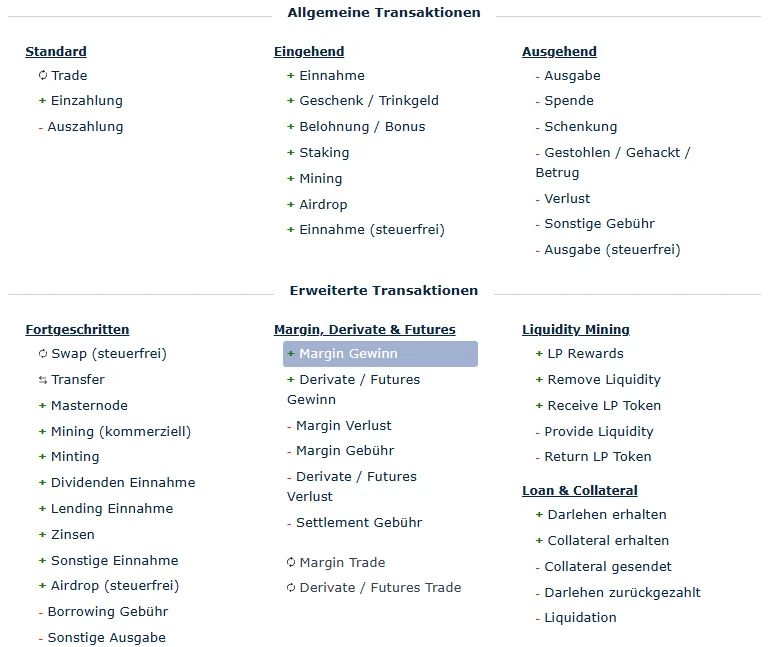
Native smart-contract recognition on blockchain import. For DeFi interactions like liquidity pools or on-chain staking, CoinTracking reads smart contracts during import and assigns matching classifications automatically. On a standard EVM DeFi setup, that saves hundreds of manual clicks.
Unbeatable filters — in practice the most important USP. CoinTracking offers 14 filter fields with Smart and RegEx toggles in advanced search. That applies not only to the transaction overview, but also to analysis pages like "Transaction Flow Report" or "Trade List". Even the "Balance by Exchange" overview provides broad filter options, e.g. to scope negative balances to a specific time range.

Specific tax-report settings. For more complex cases — in consultation with your tax advisor — the tax-report generator offers detailed options that let you tailor the report precisely to the use case. Treatment of staking, airdrops, bounties and other inflows/outflows, manual cost-basis adjustments, depot separation on or off. Everything configurable.

Filters inside the tax report, plus CSV/Excel export. Every section of the finished report can be filtered: overview of taxable and non-taxable inflows, trading gains, individual coins. Everything exports to CSV or Excel. That's not a nice-to-have, it's standard for serious documentation work or collaboration with a tax advisor.
Pricing model: subscription, not per tax year. Probably CoinTracking's most underrated strength in 2026. If you need to clean up multiple past tax years — typical after bank inquiries or supplementary requests from the tax office — you don't pay for each year separately. The license covers the entire cleanup period.
02 Where CoinTracking hits limits
For all its depth: CoinTracking is not a self-driving car. Four areas show up regularly as friction points in documentation cases with CT.
Over-trust in pre-classifications. Because CoinTracking classifies automatically, users often trust the system too much. In practice, liquidity-pool imports occasionally show inflated rewards, EUR deposits get tagged as income instead of deposit, bridge withdrawals come in as a trade against the gas fee. Smart contracts change constantly, new protocols arrive. The decentralized space moves fast, and no auto-import tool stays 100 % up to speed. A pre-classification is a hypothesis, not a final record.
1:n connections are not recognized. For decentralized swaps with multiple tokens — e.g. an NFT swapped for two others, or on Cow-Swap 1 ETH for two different tokens — CoinTracking's 1:1 logic breaks. These transactions need manual rework, otherwise either one half is missing or the cost basis is distributed incorrectly. This is not a CT-specific limit. Other crypto tax tools behave the same way. Anyone who works a lot with multi-asset swaps runs into this problem everywhere.
UI stays advanced despite the 2026 cleanup. Before 2026, CoinTracking's interface was very dense. Many users said in initial conversations, paraphrased: "this is too much, I can't find my way around". In 2026 the UI was visibly tidied up, the base structure is clearer, the most common actions are easier to find. But the underlying functionality stays advanced. Anyone who doesn't dive deep into crypto accounting quickly sees more options than solutions in CoinTracking.
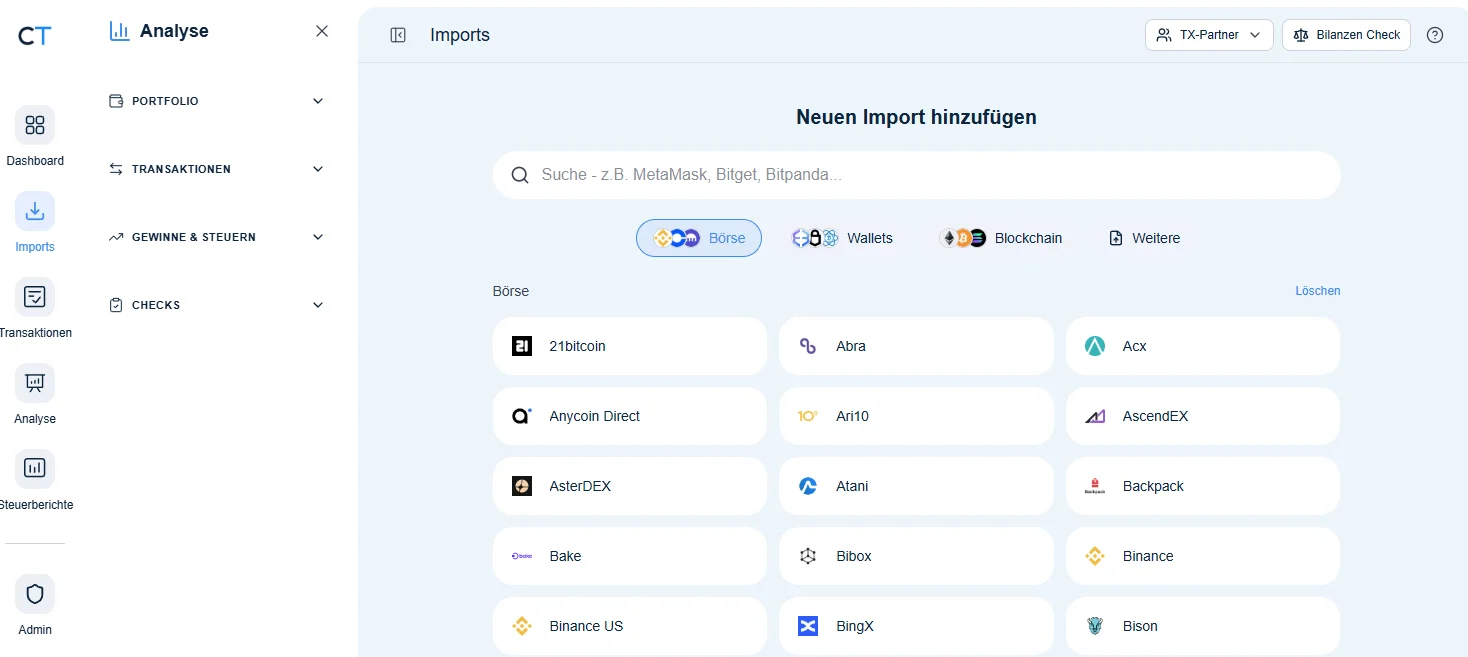
Too much freedom leads to false assumptions. The very filter depth and editing freedom that tops the strengths list can become a trap in practice. Users set filters, forget to disable them, look at partial results and form wrong assumptions. Or they edit a transaction manually and overlook that downstream the transaction flow breaks. A tool that can do anything can also be used incorrectly.
03 5 common errors from 600+ documentation cases — with click-paths
When a CoinTracking setup comes in for documentation cleanup, it's almost always the same five error patterns. In this order, because each error makes the next one more likely.
1. Missing transactions. The most common starting error: deposits and withdrawals aren't linked, so a withdrawal from exchange A "hangs in the air" without the deposit on wallet B being recognized as the counterpart. Result: the transaction flow is interrupted, acquisition costs are lost, and CoinTracking generates inconsistency error messages. Click-path to fix:
Analysis Checks Missing TransactionsIf you don't check this regularly, the later tax calculation rests on a leaky foundation.
2. Negative balances. If at any point in time an exchange or address has sold more than ever arrived, CoinTracking shows a negative balance. Three typical causes: the API doesn't deliver complete data, the CSV import contains incorrect or incomplete rows, or manual user edits have broken the classification. Click-path:
Analysis Portfolio Balance by ExchangeThe page shows not only whether negative balances exist, but on which exchange or address and which asset is affected. That's the fastest path to the root of the problem.
3. Balance changes and transaction flow. When negative balances appear or balance values change unexpectedly, the Transaction Flow Report helps. Click-path:
Analysis Checks Transaction Flow ReportHere every balance is listed chronologically: who received or gave away which asset, when and where. That's the detective view of the history.
4. Duplicate transactions. Common after importing the same data source multiple times (CSV + API in parallel, or API re-import after a tool update). Click-path:
Analysis Checks Duplicate TransactionsDuplicates are shown here. Mandatory check before every tax-report generation, otherwise CoinTracking counts the same transaction twice in your tax burden.
5. Cost basis counted as 0. The most expensive error. If CoinTracking can't find a correct cost basis for a sale because the purchase wasn't captured or the transaction flow between purchase and sale was broken, the system falls back to a default cost basis of 0. The entire sales proceed counts as gain. Click-path:
Tax Reports Tax Year Load Report Gains/Losses Show WarningsHere every trade is listed where the cost basis couldn't be assigned. Anyone who ignores this warning may, in the worst case, pay taxes on gains that exist only because of missing acquisition data and have little to do with actual reality.
Anyone who walks through these five checks before every tax report has caught 80 percent of typical CoinTracking issues. The rest is covered by the specific hubs for CoinTracking errors, missing transactions and negative balances.
04 CoinTracking pricing 2026 — is Pro or Lifetime worth it?
In 2026 CoinTracking runs on five tiers and three billing models (1 year, 2 years, Lifetime). The key figures:
| Plan | 1 Year | 2 Years | Lifetime | Trans. | Features |
|---|---|---|---|---|---|
| Free | €0 | — | — | Portfolio-only | 25+ Reports, 400+ Exchanges |
| Starter | €39 | €69 | €109 | 200 | + Tax Reports + Tax Options |
| Pro (Most Popular) | €119 | €189 | €379 | 3.500 | + Auto-Sync + API Access |
| Expert | €199 | €309 | €899 | 20.000 | + Priority Support |
| Unlimited | €719 | €1,099 | €5,599 | unlimited | + Advanced Tools + Expert Session |
Plus a 14-day money-back guarantee and "cancel anytime". On the market since 2012, with 2.2 million users according to the provider.
The Pro threshold is the most important decision. Pro is the only tier below Expert that includes auto-sync and API access. If you process more than a few manual CSVs per year, take Pro. Anything below saves on the wrong side. 3,500 transactions are enough for most retail investors across multiple years.
Lifetime pays off on multi-year setups. If you've held crypto since 2017 or earlier and stay active in the years to come, Lifetime Pro (€379) is cheaper than annual renewal after three to four years. Plus: the subscription is not tied to a tax year. If you want to clean up multiple past years, you pay only once.
We are tool-agnostic — no affiliate codes, no commission. This overview is a practical recommendation, not advertising.
05 Use cases — where CoinTracking shines, where it needs rework
Note on the scale: The rating below describes where manual rework is needed — not where CoinTracking is worse than other crypto tax tools. Other tools have similar limits on the 5-6/10 use cases. CoinTracking does a lot right across the board. Read the scale in the context of "how much documentation work remains for the power user or accounting partner."
| Use case | CT score | What that means in practice |
|---|---|---|
| CEX with API, last 2 years (Binance, Coinbase, Bitget, Bitpanda, Ledger) | 9/10 | Sweet spot — API import + default classification work reliably |
| CEX older than 2 years (back to 2017, incl. Coinbase Pro + multiple CEX products) | 7/10 | Manual adjustment likely, CSV often needed in addition |
| Standard DeFi swaps on major EVMs (Uniswap etc.) | 9/10 | Works nearly every time |
| Swaps outside EVM (e.g. Solana) or advanced orders (Jupiter DCA, bridge swaps) | 6/10 | Manual rework almost always needed |
| Standard 1:1 NFT trades on Opensea (ETH) | 9/10 | Holds up nearly every time |
| Advanced NFT trading on other platforms or chains | 5/10 | Often critical — 1:n and multi-chain specifics |
| Multichain imports (good) + bridging / bridge swaps (critical) | 6/10 | Import coverage very good, but bridges often need manual work |
Three use-case clusters emerge from this:
Sweet spot (9/10): CEX with API in the last two years, EVM DeFi standard and 1:1 NFTs on Opensea. A Ledger or Trezor as pure hold wallet causes no issues in this combination either: receive and send transactions are cleanly recognized via blockchain import. If you mostly operate here, CoinTracking gives you a setup that runs cleanly with little fine-tuning.
Manual rework needed (6-7/10): Multi-year CEX histories back to 2017 and multichain bridging. This is the typical multi-year investor with an organically grown portfolio — the largest documentation-rework group. It works fundamentally, but it needs adjustment.
Accounting partner makes sense (5-6/10): Non-EVM swaps like Solana-Jupiter with DCA or limit orders, and advanced NFT trading on less common chains. Here manual rework is almost always required, no matter which tax tool you use.
06 When CoinTracking isn't enough, and you need an accounting partner
Three signals from 600+ crypto accounting cases indicate that the tool alone is no longer sufficient:
1. Negative balances that remain after multiple correction attempts. If Balance by Exchange or your dashboard shows negative balances, you've fixed the obvious gaps and the balances still don't add up, the problem sits below the tool surface. Negative balances always come from gaps in the imports or from incorrect classifications. Finding them requires systematic detective work across histories, wallet addresses and classification logic.
2. Tax-report warnings with cost basis 0. A single warning you can check manually. When dozens or hundreds of trades are calculated with cost basis 0, the history is structurally incomplete. You don't fix that with better filtering. You fix it through clean reconstruction of the missing purchases.
3. Hundreds or thousands of missing transactions. If the "Missing Transactions" list is in the four or five digits, it means: import logic and reality have systematically drifted apart. Case-by-case correction at this scale costs more time than professional crypto accounting.
07 Crypto accounting is the foundation — CoinTracking is the tool
CoinTracking 2026 is a strong tool. Filters, classification depth, multi-year license, native smart-contract recognition: no other crypto tax tool combines all of these. If you operate in the sweet spot (CEX with API, EVM DeFi standard, 1:1 NFTs), CT gives you a clean setup.
What CoinTracking does not replace: clean preparation of your crypto transactions that leads to complete documentation. Tools calculate tax liability from what's documented. They don't fill in missing purchases, they don't reconstruct bridge withdrawals, they don't connect 1:n swaps automatically. That's what a crypto accounting partner does.
Free consultation, 30 minutes, no obligation. You either leave with a clear plan or with the confirmation that your CoinTracking setup is fine as it is.
Also relevant: When the tax tool isn't enough anymore — the accounting partner perspective on multi-year setups, DeFi depth and source-of-funds requests.
Sources & references
Sources & Date: Observations, screenshots and pricing are based on first-hand research directly on cointracking.info and on experience from crypto accounting cases with CoinTracking setups. As of: May 2026.

Co-Founder & Crypto Accounting Pioneer
Robert Thorn is co-founder of TX-Partner. Brings experience from over 600 documented crypto portfolios, from simple Bitcoin trading to six-figure DeFi setups across multiple chains and years. Closes the gap between raw data and clean documentation for tax and banks in Austria and Germany.