
Key takeaways at a glance
Koinly is in 2026 one of the most beginner-friendly crypto tax tools with over 800 integrations, strong on exchanges and standard EVM DeFi, but without a native source-of-funds feature and, to our knowledge, not fully up to date on Austria's legacy and new holdings rules.
- ✓ Austrian tax report is included in all tier plans — but recent changes around legacy/new holdings aren't, to our knowledge, fully implemented in the tool
- ✓ From our Koinly setups: pricing escalates at 30K+ trades, DE+AT compliance often needs manual rework
You picked Koinly because it works internationally, connects almost every platform, and looked simpler than local tools by comparison. On your first tax report you notice: for Germany the tool runs normally, for Austria there can be limitations around the recent changes for legacy and new holdings. And on the first bank request about source-of-funds you have no tool-native output. The question: does Koinly fit as a DE+AT setup, or does it force you into rework?
Based on our Koinly setups in practice (the sample is smaller than for the German/Austrian market leaders, but consistent), this article shows what makes Koinly really strong in 2026, where manual rework becomes necessary, which typical error patterns appear, and when an international tax tool hits its limits for DE+AT setups.
01 What Koinly 2026 really does well
Koinly has five USPs that make it the international market leader — and a serious option too.
1. First-class integration engine. Koinly covers 800+ platforms, and the list grows continuously. Anyone who follows Koinly on X sees new integrations almost weekly. If you use an exotic DEX, a new Layer-2 or an international exchange, the odds are high that Koinly already supports it before other tools do.
2. Clear UX and beginner-friendly UI. In terms of operating logic, Koinly is comparable to the UX leaders in the German and Austrian market. With a few CEX accounts, a few wallets, and normal trading activity, you find your way around Koinly fast. No overloaded dashboard, no power-user stress.
3. Extensive default labels. Koinly offers over 30 default labels (No tag, Reward, Mining, Airdrop, Fork, Lending interest, Salary, Other income, Cashback, Fee refund, Loan, Margin loan, Dust, Realized P&L, Funding fee, Futures fee, Gift, Donation, Lost, Loan fee, Other fee, Margin fee, Cost, Tax, Loan repay, Margin repay, Payment, Swap, Pool in, Pool out, Multi Trade, Liquidity in, Liquidity out). That covers practically every crypto activity without workarounds: margin trading, liquidity mining, NFT activity, lending, mining, dust corrections.
4. Established tool with a large community. Koinly has been an international key player in crypto tax for years. Large active community across multiple platforms, lively support channels, established knowledge base. If you have a question, you usually find an answer fast — even for more obscure tool functions.
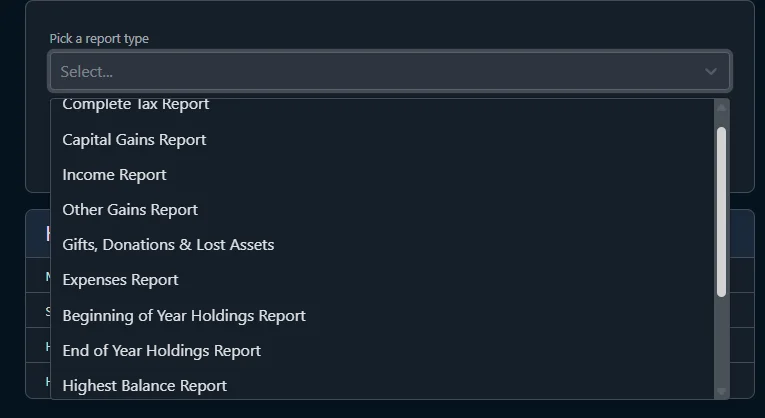
5. Reporting depth in the tax report. Koinly delivers not just the standard tax report, but a wide range of detail reports: End-of-Year and Start-of-Year reports, transaction-history download including post-edit changes (important for audit trail!), expenses report, Ledger (balance-changes) report, and more. For tax-advisor collaboration or your own audit preparation, this reporting depth is a real USP.
02 Where Koinly hits limits on DE+AT setups
For all its international strength: Koinly has four structural DE+AT gaps that show up regularly in documentation cases.
1. With many warnings, simple UI/UX becomes too little. Koinly's clear operating logic is a strength for standard setups. When your account has hundreds of Missing Purchase or Missing Price warnings, the filter depth for effective bulk editing is missing. If you have to handle complex DeFi corrections, you hit UX limits fast.
2. Austrian support: recent tax changes not fully covered. To our knowledge, the changes from the Austrian tax reform around legacy and new holdings aren't fully implemented in Koinly. An Austrian tax report is included in the tier plans and delivers a baseline, but in practice the tax-report settings for more complex Austrian cases often have to be rebuilt manually.
3. Acceptance in the German/Austrian regulatory context is lower than with local market leaders. When tax authorities or banks specifically ask for reports on crypto accounting in the German and Austrian market, they more often explicitly ask for tools established here. Koinly reports are generally accepted, but recognition in day-to-day administrative use is lower — which can lead to follow-up questions in practice.
4. Pricing escalation at high trade volume. Above the Pro tier (10,000 transactions) you have to buy 10K packs separately. With an active DeFi portfolio of 30K+ trades per tax year, you pay significantly more than with alternative tools that have unlimited trade caps.
03 5 typical error detection paths in Koinly
When a Koinly setup comes in for documentation cleanup, it's almost always the same five problem patterns. The logic is analogous to other crypto tax tools — only the naming in Koinly is a little different.
1. Missing Purchase. When an asset is sold or sent without Koinly recognizing the original purchase, it's flagged as "Missing Purchase". Click-path:
Transactions Warnings Missing PurchaseThis list must be empty before every tax report, otherwise sales get valued with an unclear cost basis.
2. Missing Prices. Some transactions Koinly recognizes, but it can't assign a EUR value based on the asset. Typical with spam tokens, very new coins or obscure trading pairs. Click-path:
Transactions Warnings Missing PricesEither mark as spam here, or set a manual value.
3. Missing Acquisition Price for Disposal: missing cost basis. The most expensive error. If Koinly can't find a cost basis for a sale, it falls back to a default cost basis of 0 — the entire sale proceeds count as gain. Click-path:
Transactions Warnings Missing acquisition price for disposalThese warnings must be addressed before tax-report generation, otherwise you pay taxes on gains that exist mathematically only because of missing acquisition data.
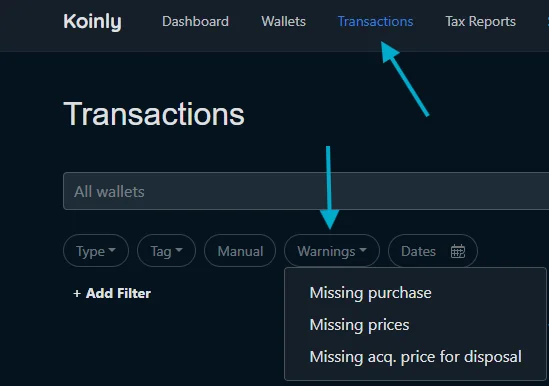
4. Spotting unlabeled transactions. Click-path:
Transactions Type: Deposit + Withdrawal Tag: "No tag"This shows all transactions Koinly recognized but didn't assign a correct label to. Important for documentation completeness.

5. Wallet sync check per exchange. Click-path:
Wallets Select exchange / wallet Check sync statusPer exchange or wallet you can see whether the sync matches the imported data. On discrepancies, there's an import problem — analogous to balance checks in other tools.
Walking through these five paths before every tax report catches 80 percent of typical Koinly errors.
04 Koinly pricing 2026 — pricing logic and DE+AT comparison
Koinly's pricing is clearly structured with tier plans per tax year:
| Tier | Transactions | Price |
|---|---|---|
| Newbie | 100 | €49 |
| Hodler | 1,000 | €99 |
| Trader | 3,000 | €199 |
| Pro | 10,000+ (buy 10K packs separately) | €299 |
Bonus options:
- Austrian tax report: included in all plans, good for Austrian users with standard setups
- Dual Nationality: +€49 (for expats with reports for an additional country)
All plans include: Unlimited revisions, unlimited wallets, comprehensive tax reports, basic portfolio tracking, email support · 1,600+ reviews on Trustpilot.
What does this mean for the decision? For casual users with a small portfolio (Newbie/Hodler tier), Koinly is fairly priced and ready to use with the Austrian tax report included. For power users with 30K+ trades, Koinly gets more expensive than alternative tools with unlimited trade caps. For multi-year cleanups you pay separately per tax year — across many retroactive years this adds up to significantly more than tools with multi-year licenses.
05 Use cases — where Koinly shines, where it needs rework
Note on the scale: The rating describes where manual rework is needed — not where Koinly is worse than other tools. Other crypto tax tools have similar limits on the 5-6/10 use cases.
| Use case | Koinly score | What that means |
|---|---|---|
| Simple CEX with API, last 2 years | 9/10 | Integration depth + strong UX |
| Multi-CEX older than 2 years (multi-year cleanup) | 7/10 | Often works very well in Koinly; cost factor rises because each tax year is billed separately |
| Standard DeFi swaps on EVM | 9/10 | Standard EVM DeFi well covered |
| Non-EVM/SOL advanced orders (Jupiter DCA, bridge swaps) | 5/10 | Manual rework almost always required |
| Multichain imports + bridging | 6/10 | Imports strong, bridges need editing |
| Source-of-funds output | 4/10 | No native compliance-report feature; constructable manually from transaction exports, but not a bank-grade multi-level trace |
Performance clusters:
9/10 strong: CEX-recent and standard EVM DeFi — Koinly's international sweet-spot zone.
6/10 rework needed: DE+AT tax-report compliance and multichain bridging. Works in principle, but needs adjustment.
5/10 critical: Multi-CEX with long history and non-EVM advanced setups. Pricing escalation plus UI limits.
4/10 structural gap: Source-of-funds output for bank inquiries. Koinly has no tool-native compliance report. That's the biggest DE+AT gap.
06 When Koinly isn't enough, and you need an accounting partner
Three signals from DE+AT setups indicate that the tool alone is no longer sufficient:
1. High share of Missing Purchase or Missing Acquisition Price warnings. When your warning list shows dozens or hundreds of entries, it isn't a filter problem. It's systematically incomplete documentation. Case-by-case correction at this scale becomes inefficient.
2. Wallet sync shows discrepancies between imported data and exchange API. If your balance in wallet sync shows red or unsynced values, you have gaps in import logic. Classic documentation detective work — more than a UX click at this scale.
3. When you need Austrian-specific tax settings or source-of-funds output. Koinly is an international tool with baseline DE+AT support, not a DE+AT specialist. If you need to exactly capture the recent Austrian changes around legacy and new holdings, or produce a bank-grade source-of-funds report, tool output alone won't get you there.
07 Koinly is a strong integration engine — DE+AT compliance is your own work
Koinly 2026 is an international market leader with 800+ platforms, clear UX, extensive labels and deep reporting. If you operate in the international sweet spot (exotic exchanges, global DEX activity, standard EVM DeFi), Koinly gives you a setup that covers more platforms than most tools specialized in Germany and Austria.
What Koinly doesn't replace: the clean DE+AT documentation layer underneath. Tools calculate from what's documented. For the recent Austrian changes around legacy and new holdings or a bank-grade source-of-funds output, the international tool frame isn't enough. This is exactly the gap TX-Partner closes: preparing the transaction data in Koinly so that the DE+AT tax calculation and a bank-grade source-of-funds report can build on it.
Free consultation, 30 minutes, no obligation. You either leave with a clear plan or with the confirmation that your Koinly setup fits your DE+AT case.
Also relevant: CoinTracking vs. Blockpit 2026: Which tool fits you? — the direct comparison of the two DE+AT market leaders.
Sources & references
Sources & Date: Observations, screenshots and pricing are based on first-hand research directly on koinly.io and on experience from crypto accounting cases with Koinly setups. As of: May 2026.

Co-Founder & Crypto Accounting Pioneer
Robert Thorn is co-founder of TX-Partner. Brings experience from over 600 documented crypto portfolios, from simple Bitcoin trading to six-figure DeFi setups across multiple chains and years. Closes the gap between raw data and clean documentation for tax and banks in Austria and Germany.